
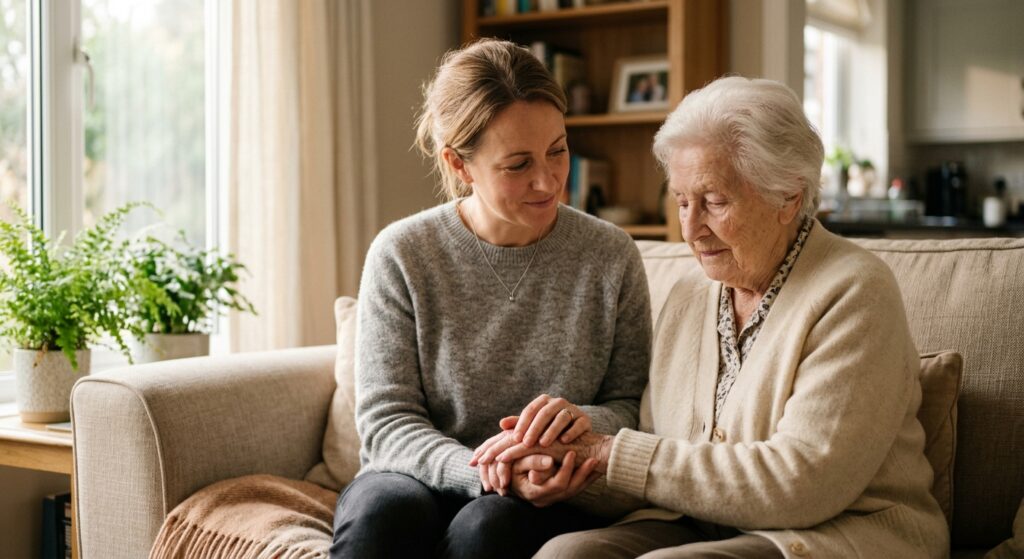
Each morning, the sun peeks through the curtains, casting a soft glow in our small living room.
It used to be a place filled with laughter and stories, but now it often feels like a weight on my shoulders, heavy with worry.
I remember the days when I could take my mom’s hand and talk about anything—her garden, her childhood, the family.
Now, the conversations have shifted.
Her questions come in a rush, sometimes repeating every few minutes, and each call becomes a tiny echo of her unease.
“Where are you, dear?” she asks, again and again.
And I hear her anxiety wrapping around me like a fog, making it hard to breathe.
It’s heartbreaking to see her peace slip away like sand between fingers.
As a caregiver, there’s guilt that comes rushing in with those repeated calls.
Should I have done more to reassure her? Should I have been there sooner?
Each sense of urgency, each flutter in my heart, reminds me that these calls are more than just questions; they’re signals of her need for connection.
I often think about what Kirstin Thomas shared on a recent podcast about her own experiences.
She talked about how her mother’s calls turned into a waterfall of worry, cascading into endless anxiety.
It made me feel less alone in my silent struggle.
In those moments when my own emotional fatigue feels overwhelming, I find myself reaching for deep breaths.
They become my tiny anchors, a gentle reset amidst swirling thoughts and worries.
I learned that offering her a sense of security meant understanding her fears and validating her emotions.
But, still, there are days when my strength feels as thin as a whisper.
In those moments, I remind myself that it’s okay to not have all the answers.
I think of how my feelings are shared by countless others in this quiet battle.
This journey doesn’t come with a guidebook, but what I have discovered is that there is beauty in the small victories.
When my mom smiles, even amid her confusion, it fills my heart.
And I learned that sometimes simply being present, holding her hand, and taking those breaths together can bridge the distance created by memory loss.
I focus on establishing routines that help both of us feel grounded.
For example, I began setting specific moments to engage with her, ensuring she knows that I’m always coming back.
This helps knit our days together, reducing the need for her endless calls.
It’s a tender balance between her need for reassurance and my own limits.
And while I navigate this path, I make it a point to acknowledge my own feelings of exhaustion.
It’s easy to let the emotional turmoil cloud my spirit, but finding moments of stillness can be a balm.
After all, self-care isn’t just about pampering; it’s about recognizing when I’ve reached my limits.
Each night, I carve out a sacred space just for me, a corner where I can breathe deeply and reconnect with who I am beyond the role of a caregiver.
As caregivers, we often carry the weight of love mixed with worry.
It’s important to remember that our feelings matter, too.
As I intuitively embrace both my vulnerabilities and my resilience, I learn to cultivate grace for this journey.
So, when the phone rings and it’s her voice asking, “Where are you?” I remind myself I am here, and it’s okay.
These moments, though fraught with emotion, lead me to a deeper understanding of love’s endurance.
Every question, every call, is a reminder that I am not just a caregiver, but a daughter navigating the tides of change with her.
Together, we find our way through the echoes.
And though the road may be sometimes dim, it’s also filled with tender moments of connection.