
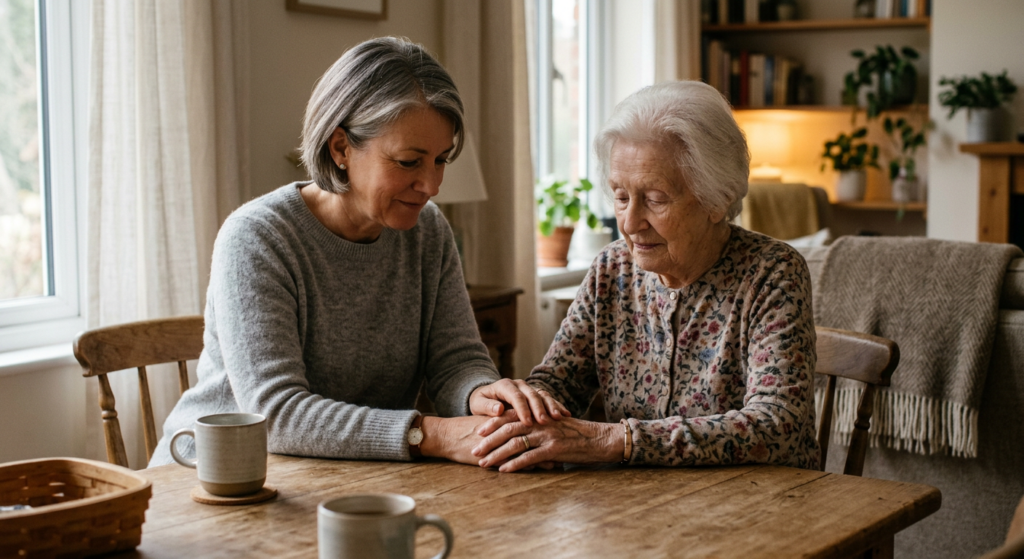
I remember the day I first realized how fragile everything had become.
My mother, once the bedrock of our family, seemed to be losing herself piece by piece.
Her laughter, the spark of her spirit, felt like echoes in an empty room.
As her memory fading gradually turned into dementia, I found myself wearing many hats.
I became her caregiver, her source of calm, and at times, her lifeline.
It’s hard to put into words the weight of those moments.
Some days, I felt like I was drowning in grief, battling the waves of despair that crashed over me.
Other times, I would feel like I was standing on solid ground, cherishing the small victories as we navigated our new reality.
Cognitive decline can feel like a thief lurking in the shadows, stealing away the person we once knew.
It brought an overwhelming sense of loneliness, even in a crowded room.
In the quiet of the evening, after the sun had set and the world fell silent, I often questioned if I was doing enough.
Was I making the right decisions? Could I be doing more?
Those thoughts spiraled, weaving a web of guilt and exhaustion.
Then one night, after a particularly difficult day, I stumbled upon a podcast featuring a conversation about new advancements in dementia care.
What caught my attention was the idea of using technology to support our loved ones.
It was a small spark amidst the heavy fog of despair.
With a little research, I learned about programs like NewDays, utilizing AI to provide personalized cognitive treatments.
It dawned on me that this technology could offer my mother the support she desperately needed.
Exploring this option lightened a piece of my heart.
It reminded me that I was not alone; there were avenues for help.
Of course, change is often intimidating.
Letting go of some control felt daunting, but I realized supporting her didn’t mean losing myself in the process.
By reaching out, I was asserting my love for her, trusting that it would be okay to seek help.
Taking this step created room for breath, opening a channel of hope where there had been none.
As I embraced this new approach, I noticed shifts in our days.
We found joy in the little things – the warmth of sunshine filtering through the curtains, the serenity of afternoons spent together over tea.
These simple calming moments anchored us, reminding me of our shared love.
I also began to practice mindfulness, allowing space for both my emotions and hers.
I learned to balance the onslaught of feelings, remaining present while letting go of burdens that didn’t belong to me.
This wasn’t just about her journey but about mine as well.
Those nightly sessions of mindfulness became a ritual, fueling my strength in ways I hadn’t expected.
They were a gentle reset for both of us; a reminder that we could still connect, even amid sorrow.
We don’t always live in the past; our hearts are open to the present and what is yet to come.
As I reflect on this journey, I understand that caregiving is a tapestry woven of love, hope, and resilience.
Indeed, there are moments of deep exhaustion, but they are paired with sparks of joy that make us feel alive.
If you ever feel overwhelmed, know that it’s okay to seek help and to be gentle with yourself.
As caregivers, our emotional balance is sacred; it’s how we find the strength to guide our loved ones.
Let’s take gentle steps together, allowing space for healing and nurturing our shared love.
Remember, we are not alone in this.
Every day is a chance to breathe anew.