
There’s a profound sadness that lingers in the air when you’re a caregiver, one that often goes unspoken.
It’s that quiet grief, the heavy heartache of watching someone you love slowly slip away.
As I cared for my mother during her struggle with Alzheimer’s, I often felt torn between the joy of her company and the pain of her gradual decline.
In many ways, I was grieving even before she was gone.
Every day felt like a dance between memory and loss, and the weight of this grief seemed almost unbearable at times.
It’s a strange position to be in, loving someone deeply while witnessing their retreat into a fog.
Conversations turned from shared laughter to moments filled with silence, leaving a gap where connection once thrived.
Anticipatory grief was a constant companion, whispering reminders of how things used to be.
The tiniest declines felt monumental, like losing her all over again.
Even the act of feeding her felt tinged with a bittersweet essence; food shared once became a task, a means of survival rather than sustenance for the soul.
In the early days, I fought fiercely against this shift.
I sought to preserve every flicker of the person I knew.
But as months turned to years, I learned that grief is not only about final goodbyes.
It’s about every single moment spent navigating the unknown, about finding new pathways of connection amid deepening shadows.
There were days when I felt consumed by a relentless cycle of exhaustion and joy.
Exhaustion, as I found myself pouring every ounce of my energy into her care, often forgetting to take a breath for myself.
And joy, as there were fleeting moments when she’d smile or say my name, and everything would feel right in the world.
They say caregiving is a labor of love, but no one talks about the personal toll it takes.
You wear the invisible burdens of guilt and sadness like heavy clothes while trying to offer support and light.
Even in my struggle, I found allies in other caregivers who understood this unseen emotional hardship.
We shared stories filled with triumph and heartbreak, finding solace in our connection, in the raw honesty of our experiences.
A powerful lesson emerged from those conversations: it’s okay to grieve while they are still here.
It’s valid to acknowledge that loss is not solely tied to death but comes in stages.
Every time she forgot a name or lost a bit of herself, I experienced a miniature heartbreak.
Learning to embrace these feelings, to understand that they shape my journey, became a crucial part of my caregiving experience.
And so, I took to creating small rituals to honor those feelings.
Whether it was a moment in nature, a warm cup of tea, or simply allowing myself to cry when I needed to, these practices forged a pathway for emotional renewal.
It reminded me that while my mother was slipping away, our bond remained strong, even if it transformed.
A gentle reset became essential; grounding myself in the present helped me navigate the emotional rollercoaster.
Emotional stability as a caregiver isn’t just a lofty goal; it’s a necessity.
Finding small joys amidst the challenges became a lifebuoy.
Though my mother and I were often enveloped in silence, there was still a bond connecting us.
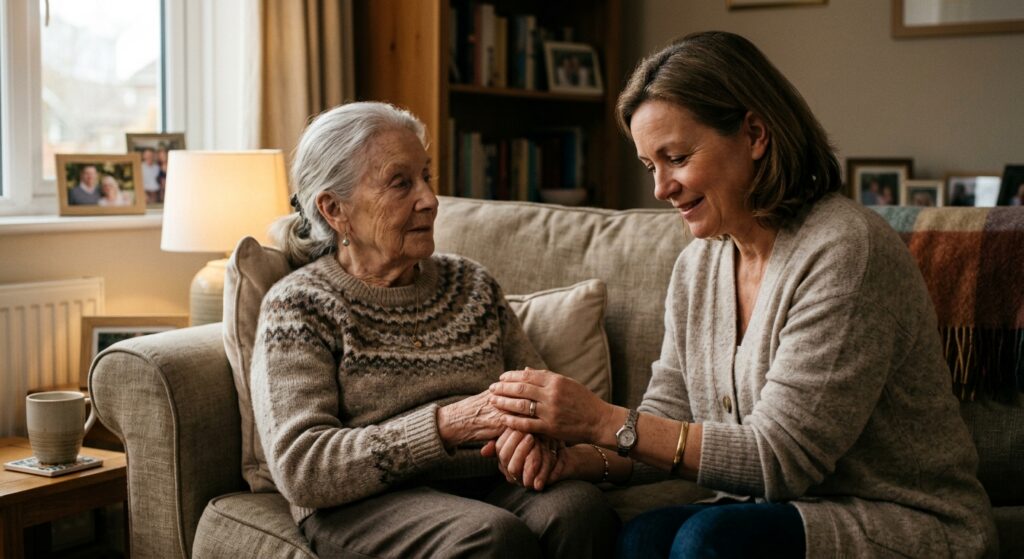
I learned to appreciate the small moments, a gentle squeeze of her hand, the warmth of her gaze, the peacefulness in shared silence.
It was a journey laden with stress but also rich with layers of love.
There were times I felt I was losing my identity or drowning under the weight of emotional overload.
I reached out to support networks, seeking understanding and companionship.
Listening to others’ stories reminded me I was not alone in this labyrinth of care.
Every shared word became a bridge between our experiences, offering hope in the darkest hours.
My mother may have been lost to Alzheimer’s, but through her, I discovered the strength I never knew I had.
This experience has taught me that grieving while caregiving is part of the journey, a testament to the love we hold onto amid uncertainty.
So here I am, still navigating this path, carrying both love and grief, learning to breathe through the pain.
And in this dance of caregiving, I’ve slowly started to understand that hope can exist hand in hand with sorrow.
As we honor our loved ones, may we also honor ourselves.